
Jeremy Arevalo Arrives at VfB Stuttgart but Struggles to Find His Footing
Autor nqqn.org, Apr 15, 2026
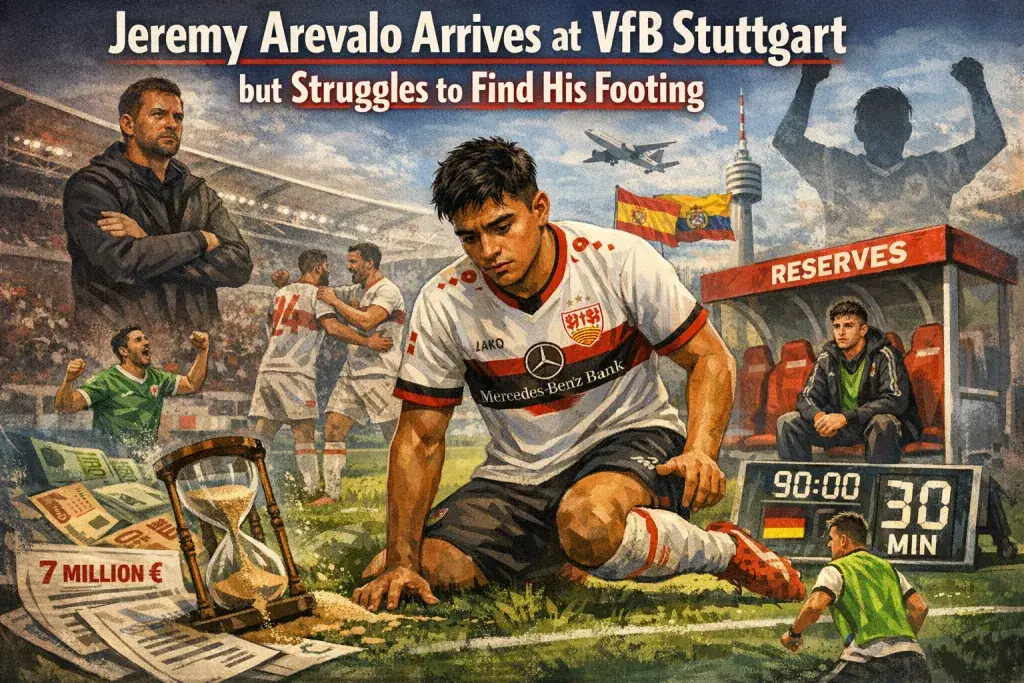
Seven million euros and a contract running to 2031: VfB Stuttgart committed significant resources to sign Jeremy Arevalo from Racing Santander in the winter window, yet four months into his time on the Neckar, the 21-year-old Ecuadorian has accumulated barely 30 minutes of Bundesliga action across six appearances. The gap between the club's ambition and the forward's current contribution is wide — and growing harder to ignore.
A Window Shaped by Misfortune and Missed Opportunities
The circumstances that brought Arevalo to Stuttgart were not straightforward. The departure of Nick Woltemade to Newcastle United for £75 million left a structural void in Sebastian Hoeneß's frontline that the club had, by the head coach's own admission, already failed to adequately address. Hoeneß stated publicly that the squad had not met targets set the previous summer — a pointed rebuke of the club's recruitment strategy delivered before Woltemade had even officially left.
The subsequent arrivals of Badredine Bouanani and Bilal El Khannouss addressed width and creativity but not the central goalscoring role the squad lacked. A move for South Korean forward Hyeon-gyu Oh from KRC Genk collapsed on deadline day when he failed his medical examination. Ermedin Demirović, who had contributed five goals since early October, sustained a complex foot injury that extended his absence well into the new year. Bilal El Khannouss was away on international duty with Morocco at the Africa Cup of Nations. With the attack depleted and the winter break approaching, the path to Arevalo was partly cleared by injury and circumstance rather than pure tactical design.
The Difficulty of Transitioning Between Football Cultures
Arevalo arrived from the Spanish second division — a competitive but structurally different environment to the Bundesliga, where pressing intensity, spatial discipline, and physical demands operate at a markedly higher level. The adjustment required of any young forward making such a step is considerable, and the compressed timeline of a winter arrival — with no pre-season preparation, no gradual integration into training rhythms, and immediate exposure to a high-pressure environment — rarely produces instant returns.
Hoeneß acknowledged as much in February, noting that Arevalo had come from "a different league, a different culture" and that while the club had hoped for faster progress, the possibility of a slower start had always been understood. Spanish-speaking teammates, including Chema Andres, were tasked with easing his cultural transition — a detail that reflects the club's awareness of how profoundly off-field disorientation can affect on-field performance. Yet awareness of a problem and the ability to solve it quickly are not the same thing. Arevalo was omitted from the Europa League squad, left out of the Bundesliga matchday selection four consecutive times, and temporarily assigned to the reserves — a trajectory that reflects both the depth of the first-choice options available and the distance he still needs to cover.
What the Numbers Reveal — and What They Conceal
The raw figures are stark: one assist, 30 minutes of Bundesliga involvement, and a single reserve appearance in which he scored and created a goal in a 3-1 win over SV Waldhof Mannheim. That cameo offered a glimpse of the pace and directness that persuaded the club to activate his release clause in the first place. It also underlined the gap between what Arevalo can produce in a lower-pressure context and what has so far been possible at the senior level.
Sporting director Fabian Wohlgemuth has publicly maintained confidence, describing the club's belief in Arevalo's "potential" and pointing to the long-term nature of his contract as evidence of institutional commitment rather than short-term thinking. That framing is reasonable — clubs routinely sign young forwards for development as much as immediate contribution — but it sits awkwardly alongside the explicit need for a goalscorer that drove the acquisition in the first place. A €7 million outlay on a long-term project is a different proposition to a €7 million emergency solution, and Stuttgart's winter predicament demanded the latter.
A World Cup Complication and the Months That Will Define the Investment
Arevalo carries additional pressure beyond his club situation. As a three-time Ecuador international, he is pursuing a place in Ecuador's World Cup squad — and Ecuador has been drawn in the same qualifying group as Germany, meaning some of his club colleagues could become direct opponents on the international stage. Ecuador's head coach Sebastian Beccacece gave him two late appearances during the recent international break, a signal of sustained faith from the national setup even as his club minutes remain limited.
The weeks remaining before the summer recess represent a narrow window. Demirović has returned from injury, El Khannouss has been signed permanently after impressing on loan, and Bouanani — despite his own inconsistency — remains in contention. The competition for forward positions is genuine, and Hoeneß has shown no reluctance to leave Arevalo out when he judges others to be ahead. Whether the Ecuadorian can force his way into regular consideration before the season ends will not only shape his immediate future in Stuttgart — it will determine whether a club that spent heavily and planned imperfectly in January can count this particular decision among its recoverable ones.